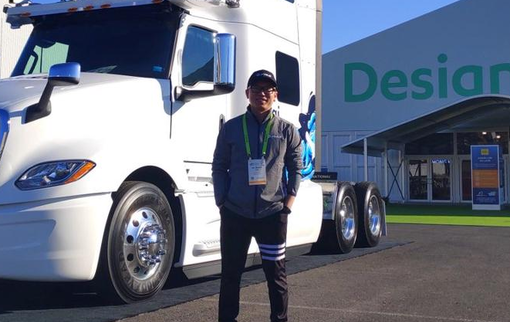
In 2017, the autonomous driving sector was poised for explosive growth. At the time, Cui Dixiao was an ordinary lecturer at Xi’an Jiaotong University; while the academic position offered stability and comfort, it could not quell his inner drive to pursue autonomous driving. Realizing that the moment for real-world deployment had arrived and fearing he might miss this wave of innovation, Cui began considering leaving academia to start his own venture.
Shortly thereafter, Liu Wanqian—CEO of Plus (Zhijia Technology), a startup focused on autonomous driving technology for heavy-duty trucks—flew to Xi’an to invite Cui to join the company. The two met at the Westin Hotel near Xi’an’s Giant Wild Goose Pagoda, conversing from 3:00 PM to 8:00 PM. During those five hours, Liu shared his entrepreneurial journey, outlined Plus’s competitive advantages, and articulated the company’s vision: to enter the market via driverless trucks and drive the adoption of Level 4 (L4) autonomous driving in China’s long-haul logistics sector—a mission for which they needed a technical lead for autonomous driving.
At that time, PhDs and professors like Cui—who possessed both deep theoretical knowledge and extensive practical experience—were highly sought-after talent in the autonomous driving industry. Liu sought out Cui not only because of his impeccable credentials in the field—holding a PhD in Control Science and Engineering from Xi’an Jiaotong University under the mentorship of Academician Zheng Nanning (a titan of Chinese autonomous driving) and having completed a joint doctoral program at the University of Parma’s VisLab—but also because of his hands-on achievements.
Most importantly, Cui had participated in the development of numerous driverless vehicle projects during this period. As a founding member and team leader, he contributed to the development of successive generations of the “Kuafu” (Father of the Sun) driverless vehicle series, leading the Xi’an Jiaotong University team to prominence in the China Intelligent Vehicle Future Challenge. Additionally, during his joint training at the University of Parma’s VisLab, he worked on the development of vehicles such as BRiVE (the first vehicle globally to complete a live-streamed public road test across mixed suburban, highway, and urban environments in 2013) and Deeva (the world’s first vehicle featuring 360-degree stereo vision perception). Ten days later, Cui Dixiao accepted the offer. He left Xi’an—the city where he had lived and worked for 13 years—to join Plus (Zhijia Technology), headquartered in Xiangcheng, Suzhou, as Chief Scientist. There, he spearheaded the R&D and practical deployment of L4 autonomous heavy-duty truck technology, marking the beginning of a career in autonomous driving that would span nearly a decade.
Time flies. Seven years later, in 2025, Cui Dixiao officially announced his departure from Plus. Over those seven years, China’s autonomous driving sector underwent earth-shattering changes, cycling through periods of boom and bust, while Plus itself grew into a unicorn in the field.
During Cui’s tenure as technical lead, Plus achieved remarkable technological breakthroughs and commercial milestones. Starting in 2021, the company collaborated with multiple OEMs to deliver mass-produced smart heavy-duty trucks; these included factory-installed smart trucks produced with FAW Jiefang and the mass delivery of the K7+ model—co-developed with JAC Motors—for the express delivery market. Smart trucks equipped with Plus’s proprietary, full-stack “PlusPilot” system entered commercial operation on routes for major logistics firms such as China Post, ZTO Express, and ANE Logistics. Additionally, the company partnered with Sinotruk to deliver the Howo TS7—a heavy-duty truck featuring advanced driver-assistance systems powered by PlusPilot—and successfully conducted China’s first “warehouse-to-warehouse” L4 fully driverless heavy-duty truck operational test.
Seven years is enough time to transform both an individual and a company. Reflecting on the ambitious young man who once resolutely plunged into the wave of “realizing the L4 dream,” Cui Dixiao candidly admits that he had “underestimated the complexity of autonomous driving” at the time. He believes that the essence of L4 lies in redundancy-based safety assurance. However, most people currently stake customer safety on algorithmic systems they perceive as infinitely capable, betting on probabilities through isolated systems rather than ensuring safety via multi-system redundancy—a fundamental difference in design philosophy and mindset. Reflecting on his journey at PlusAI (智加科技), Cui Dixiao frankly admits to having some regrets—the kind of regrets likely shared by anyone who still holds onto the ideal of autonomous driving today. Cui is also a rock music enthusiast with striking tattoos; during the interview, one could sense a blend of traits from both a rocker and a tech professional—rigorous yet authentic.
His social media profile features a background image of his favorite musician, Paul Wong (Wong Koon-chung), and a signature line reading “Driverless Rock ‘n’ Roll Heavy-Duty Truck.” This fusion of heavy-duty trucking and rock music carries a touch of romance and idealism. Now, the young man from seven years ago is approaching middle age, and while he hasn’t been able to form a rock band in a long time, his belief in autonomous driving remains steadfast, and he continues to dream.
We recently spoke with Cui Dixiao about how the industry has reshaped his perspective over the seven years since he first immersed himself in the world of autonomous driving—specifically the effort to bring L4 autonomy to China’s long-haul logistics sector—and discussed his plans for the future.
The following is a transcript of the conversation between Leiphone (雷峰网) and Cui Dixiao, edited for clarity without altering the original meaning:
01
Re-exploring an organizational model that facilitates L4 deployment
Leiphone: Why did you leave PlusAI?
Cui Dixiao: It was a natural choice based on the industry landscape and my own reflections.
In the past, many autonomous driving companies adopted a strategy of pursuing L2 and L4 development in parallel. Conceptually, this model was ideal: companies would bet on high-level L4 autonomy while simultaneously hoping that L2 driver-assistance systems would drive rapid commercialization and generate revenue to subsidize the long-term, costly R&D required for L4—which is difficult to monetize in the short term.
However, in practice, this path faced significant real-world challenges. Companies generally faced resource constraints, making it difficult to sustain parallel development tracks over the long haul. At the same time, the commercialization of L2 driver-assistance systems did not go smoothly.
Simply put, trying to fund high-level L4 R&D with profits from L2 systems is essentially like “using revenue from the bicycle industry to fund investment in the aerospace sector”—it is not sustainable. I left Plus because, during my tenure there, I was unable to find a clear, viable solution to the common industry challenges mentioned earlier. By leaving, I can engage in open and transparent dialogue with the industry from a more independent standpoint; this actually makes it more likely that I can explore organizational models and development paths that facilitate the steady deployment and sustainable growth of L4 technology.
Leiphone: What kind of organizational structure are you looking for?
Cui Dixiao: I am looking for an organization that commits stable, sustained resources to L4 autonomous driving and positions L4 as its top—or even sole—core strategy.
For a long time, the industry has largely approached L4 from a purely technical perspective. However, L4 is not merely a technical issue; it is a systemic challenge requiring the deep integration of multiple dimensions, including road infrastructure, freight sources, vehicle hardware, software algorithms, and energy replenishment systems.
Take heavy-duty trucking as an example: the core value of L4 autonomous driving lies first in saving labor costs. Building on that foundation, by continuously optimizing software and hardware architectures as well as operational dispatch systems, we can improve overall vehicle turnover rates. On certain routes, this could even enable 24-hour continuous operation, thereby generating incremental revenue.
Therefore, what I am truly seeking is an approach that integrates specific application scenarios, road access rights, freight sources, and energy replenishment systems to deploy and operate L4 as a complete ecosystem, rather than stopping at the level of technical R&D or prototype demonstrations.
Leiphone: Do you plan to start your own business or join an existing company?
Cui Dixiao: My first choice is to start my own business, focusing once again on the logistics industry. This decision is based on three key considerations:
First, the logistics industry operates on rigid pricing logic, which compels teams to continuously optimize costs across the supply chain and R&D processes. Industry participants strictly calculate return on investment (ROI), and this rigorous business environment hones a team’s most solid, fundamental core capabilities. Second, from the perspective of technology and engineering implementation, logistics scenarios impose specific requirements regarding timeliness, safety, and cargo characteristics. These can be directly translated into clear, quantifiable engineering design metrics—such as strict upper limits on acceleration and rates of change in steering—enabling the creation of safe, controllable, and standardized engineering specifications that allow for a high degree of standardization for specific B-side clients.
Third, logistics is a massive market worth trillions. While current scenarios are highly fragmented, technology promises to bridge these gaps in the future. We will see the emergence of logistics robotics companies that utilize a single underlying technology platform to cover various payload capacities and speed ranges, thereby integrating the logistics chain and consolidating the currently fragmented landscape.
Furthermore, if non-transportation segments of the existing workflow—such as last-mile delivery and loading/unloading—can be automated, it would enable deep vertical integration between the operational environment and the tasks themselves; this represents both a core bottleneck and a major opportunity for the logistics industry. Consequently, I plan to build a strategy encompassing software, hardware, and delivery models, while maintaining the conviction that autonomous driving companies should ultimately evolve into providers of transportation capacity services.
Leiphone: That sounds like the “Embodied AI” sector. Are you moving away from autonomous trucks?
Cui Dixiao: It is highly unlikely that I will enter the market directly through autonomous trucks—though nothing is set in stone yet—but I will eventually circle back to that area via a suitable path. It is like taking a different route to Rome; the destination remains the same, and I will ultimately converge with the rest of the industry on that shared goal.
Leiphone: After leaving Plus (Zhijia), did any other autonomous driving companies or their personnel invite you to join them?
Cui Dixiao: Yes, Cao Xudong reached out to me at one point, inviting me to lead their autonomous truck business.
Leiphone: Why didn’t you accept?
Cui Dixiao: To me, life is a journey of self-cultivation and experience. My time as an executive and early team member at Plus provided me with a comprehensive professional education. I wanted to step outside the technology-centric perspective I had held previously to re-examine the industry and explore new possibilities for my career; that is why I am currently inclined to start my own venture. 02
The Importance of Redundancy for L4
Leiphone: Having spent so many years in the autonomous driving industry, do you hold any views that run counter to the prevailing consensus?
Cui Dixiao: Rather than calling it “counter-consensus,” I would describe it as a form of critical self-reflection—or even “self-negation”—for those of us with technical backgrounds: we need to let go of the obsession with “algorithmic premiums” or the idea that algorithms constitute the core competitive barrier. While algorithms from different teams may vary in performance, they rarely form an absolute competitive moat.
At the same time, however, L4 autonomous driving involves a vast amount of indispensable work that doesn’t necessarily yield immediate, tangible results—work that might seem like it doesn’t “put food on the table.”
Leiphone: Such as?
Cui Dixiao: Why haven’t we been able to truly eliminate the safety driver yet?
Leiphone: Indeed—why is that?
Cui Dixiao: The crux of the issue is that we haven’t yet built a truly safe and reliable redundancy system. Back at my previous company, I constantly advocated for increased investment in redundancy design and suggested drawing on mature practices from the aerospace industry—such as triple or quadruple redundancy and dissimilar redundancy designs.
Leiphone: What does “sufficient redundancy design” actually entail?
Cui Dixiao: The aerospace industry offers mature reference data for this kind of design. The core logic is actually quite simple—akin to the saying that “three heads are better than one.” Put simply, the more independent, reliable sources of observation and decision-making you have, the higher the system’s overall reliability and the lower the probability of failure.
However, redundancy design faces practical challenges: it directly increases vehicle hardware costs. Furthermore, the better the redundancy system works, the harder it is for stakeholders to perceive its value—because the vehicle continues to operate smoothly, making the redundancy system seem invisible or even “superfluous.”
Leiphone: Do low-speed Robovans require redundancy? Cui Dixiao: The fundamental premise for determining whether a low-speed Robovan requires redundancy is this: without redundancy, would the consequences of a system loss of control be unbearable—even if such an event has an extremely low probability?
Therefore, for companies focusing on low-speed Robovans, the core task is a cost-benefit analysis: comparing the R&D costs of adding redundant hardware and software against the potential losses from system failure—such as cargo damage, vehicle damage, or casualties—to see which approach offers better cost control and lower overall expense.
Current industry thinking regarding Level 4 (L4) autonomy has shifted from purely technical exploration to commercial cost analysis. If mature hardware and software solutions exist, and if large-scale operations can amortize software R&D costs, the venture becomes commercially viable when the expected loss from system failure is far lower than the cost of implementing redundancy. Tesla is currently pursuing precisely this commercialization path based on mathematical calculations.
Leiphone: You have consistently emphasized the importance of redundancy design to achieve truly safe, driverless operation. What relevant research have you conducted in the past?
Cui Dixiao: During my time at Plus (Zhijia Technology), I initiated a relevant research project, though it was ultimately not completed.
At the time, we were working to validate the concept of transitioning from a “dual-driver” to a “single-driver” model in commercial vehicle operations. For long-haul trunk transport covering 800 kilometers or more, regulations require a driver to rest after four hours of driving; consequently, the industry typically assigns two drivers to take turns. We wanted to explore whether—before fully eliminating the need for two drivers—we could use autonomous driving technology to reduce the requirement from two drivers to one. Internally, we called this the “D2S” (Double to Single) project.
I conducted a systematic study on the causes of driver fatigue and ultimately categorized them into two types: physical fatigue and cognitive fatigue. Based on this, we conducted extensive experiments. Early attempts involved using EEG to monitor and analyze how different brainwave bands fluctuated during driving. Later, we adopted a more practical approach: utilizing multi-dimensional data—such as eye-tracking, bio-electrical signals, skin conductance, respiration, heart rate, breathing depth, and blink frequency—combined with the driver’s visual attention to road targets. We used this data to comprehensively assess whether a driver’s cognitive load and physical fatigue could be significantly reduced when assisted driving systems were engaged.
We employed a quantitative comparison method: using fatigue metrics from four hours of manual driving as a baseline, we compared the fatigue levels experienced during continuous solo driving with assisted driving enabled. For instance, if the fatigue level after four hours of manual driving was comparable to that after ten hours of continuous driving with assistance, it implied the vehicle could travel for ten hours straight without requiring an additional driver.
Throughout the research, we also deeply considered a critical question: Should the MPI (Human-Machine Interaction/Takeover Intensity) of assisted driving systems be set very high? Our ultimate conclusion was that the MPI should not be excessive.
Leiphone: Why?
Cui Dixiao: Assisted driving systems lack comprehensive mechanisms for handling system failures; theoretically, the driver must take over immediately if a failure occurs. However, human nature involves a tendency toward complacency: if a system remains stable over long periods and rarely triggers risk alerts, the driver’s safety awareness and attention levels tend to decline. A scenario requiring a takeover might only arise after 1,000 or 2,000 kilometers of driving; these are often extremely rare “corner cases” that are difficult to handle even for a human driver.
This means it is difficult for a driver to instantly transition from a state of total relaxation—where they are not actively thinking about driving—into a highly complex scenario, make a rapid, accurate judgment, and safely take control of the vehicle. This is why I believe that during the L2 stage of automation, one should not blindly pursue extremely high MPI levels or treat them as a primary safety metric; doing so is essentially a gamble on probability.
Following this line of reasoning, our research also focused on how to ensure drivers…During assisted driving, it is essential to maintain a basic level of alertness regarding the road environment.
To this end, we conducted specialized cognitive experiments: after attaching micro-electrodes to the driver, testers applied mild electrical stimulation and instructed the driver to perform specific actions immediately. We then precisely measured the reaction latency—the time elapsed between receiving the signal and executing the action. If the reaction speed deviated significantly from the normal range, the system would intervene via algorithms to restore the driver’s alertness to a safe level.
Leiphone: Has there been any prior research in this field?
Cui Dixiao: The vast majority of people in the industry haven’t really thought deeply about these issues; most are essentially betting on probabilities. They entrust users’ lives to algorithmic systems they believe can be infinitely improved, relying on a single system to manage risk rather than ensuring safety at the fundamental level through multi-system redundancy. This represents the core difference between our approach and the industry mainstream regarding underlying design philosophy.
03
Why hasn’t domestic L4 achieved “driver-out” status (routine operation without a driver in the seat) yet?
Leiphone: In your view, what is the current state of domestic L4 development?
Cui Dixiao: The domestic L4 sector has been developing for years, yet no single company has achieved routine “driver-out” operations. The industry is now mired in a predicament where expectations and investor confidence are being constantly depleted. Everyone in the industry is gradually realizing that the complexity of autonomous driving far exceeds initial expectations; ultimately, how far a company can go depends largely on its strategic resolve.
However, the domestic environment has very little tolerance for long-cycle technology R&D. It’s not that engineers lack the desire or willingness to do the work; rather, capital providers—as well as primary and secondary markets—fall far short in terms of financial support and patience regarding timelines. This makes it difficult to maintain the patience required to navigate a development process characterized by long cycles, high investment, and slow returns.
Leiphone: So, how can this problem be solved?
Cui Dixiao: Solving this in the future might require the involvement of state-owned capital, though I’m not certain; I haven’t yet seen a viable path or method. Taking a broader view, the “Robotruck” sector’s shift toward resource-based transport models—rather than general commercial transport—is an approach that has gained significant industry recognition. Leiphone: What is the core difference between “resource-based” transport and “commercial” transport when it comes to driverless operations?
Cui Dixiao: Long-haul transport in China falls into two categories: resource-based transport and commercial transport. Because their operational scenarios and requirements differ, the core challenges and implementation difficulties associated with driverless technology also differ fundamentally.
Resource-based transport involves moving production materials—such as non-ferrous metals or coal—from their source to processing sites. These operations feature fixed routes and high transport volumes; regions rich in resources, like Xinjiang and Inner Mongolia, can handle tens of millions of tons annually. This stability provides an excellent foundation for testing and deploying driverless technology. Furthermore, because time-sensitivity is low, vehicle speeds can be moderated; this exponentially reduces the risks and potential costs associated with system failures, thereby better ensuring the safety of heavy-tonnage vehicles.
Commercial transport is a completely different story. Exemplified by express delivery services (such as ZTO, YTO, STO, and Yunda), it involves moving goods from factories to end consumers. It demands high efficiency, emphasizing next-day or even same-day delivery. Vehicles must travel at high speeds on standard highways, which significantly increases technical complexity. Moreover, the risk associated with system failure is extremely high; a safety incident would not only cause direct loss of life and property but could also trigger an industry-wide crisis of confidence, stalling development or even forcing some companies to shut down.
At the same time, the pressure for timely delivery makes “platooning”—a common practice in the industry—virtually impossible to implement in commercial transport. Since vehicles lack the spare time to coordinate and form convoys, driverless trucks must rely on autonomous, individual operation, further raising the technical bar.
Leiphone: Aside from platooning, are there any other feasible approaches?
Cui Dixiao: At the national level, proposals have been made that I believe are quite feasible, even though they haven’t been fully implemented: establishing dedicated lanes for autonomous heavy-duty trucks to physically separate them from human-driven vehicles. From a societal perspective, this model of separation could be a viable path to overcoming the current hurdles facing the deployment of driverless heavy trucks.
Leiphone: If access rights to public roads were opened up on a large scale, would that significantly accelerate the large-scale adoption of driverless trucks? Cui Dixiao: One cannot simply assume that granting road access rights will lead to the large-scale deployment of driverless trucks. Scaling up requires coordination across a multi-dimensional ecosystem; road access is merely one link in that chain. The core issue regarding road access is policy ambiguity, but the root cause lies in the fact that companies have not yet achieved routine driverless operations. Consequently, they cannot provide the government with sufficient operational proof, safety evidence, and real-world data to justify expanding pilot programs. This creates a stalemate where the opening of road access and actual corporate deployment are essentially waiting on one another.
KargoBot’s approach offers an excellent model for the industry. By forging deep partnerships with the government and steadily exploring possibilities within the bounds of technical feasibility, they avoid the hype surrounding commercial transport. Instead, they focus on resource-based transport scenarios that are easier to implement. By breaking down scenarios to lower technical complexity and failure risks, they encourage the government to grant road access and support pilot programs. A company’s willingness to take a step back—rather than seeking an overnight solution—can actually drive steady industry progress.
04
“Companies that excel at both L2 and L4 are few and far between.”
Leiphone: How should we evaluate the technical capabilities of an L4 company today?
Cui Dixiao: No single metric suffices to evaluate an L4 company’s technical capabilities; it is inherently a complex, multifaceted evaluation system.
The industry used to frequently cite MPI (Miles Per Intervention). However, when I speak with companies claiming to develop L4 technology today, if they still treat MPI as a core metric, I feel they have gone off track—or are even “doomed.”
This is because MPI is fundamentally not the right metric for evaluating L4 systems. The core of “intervention” is human involvement, whereas the core of L4 is a driverless system; using a metric based on “human intervention” to evaluate a “driverless system” is inherently contradictory and odd. A human taking control after an accident occurs is a reactive measure—it implies the system has already encountered an uncontrollable scenario it could not handle and required human remediation. That is the true nature of MPI. There has been much discussion regarding leading automakers like Tesla, Xpeng, and Li Auto. Their vehicles often abruptly disengage from autonomous driving—forcing the human driver to take over—when an obstacle is just 0.3, 1, or even 3 seconds away. Consequently, even if a crash occurs, it technically appears to be a case of human error. However, viewed from the ultimate goal of L4 autonomy—which demands absolute safety—this mechanism of handing over control during critical L2 scenarios is essentially a “shady tactic.”
True L4 autonomy requires proactive risk assessment: detecting anomalies and averting danger before the system fails or a risk materializes, rather than attempting damage control after an accident has already occurred. To use an analogy: my goal is to sound the air-raid siren and prevent the threat beforehand, not to inform everyone about what happened only after the bombing is over.
This reflects a fundamental shift in thinking. In the past, many people deluded themselves into believing that simply pushing the MPI (Miles Per Intervention) to an extremely high level would bring them closer to L4; in reality, that was a misunderstanding of what L4 entails.
Leiphone: Over the past few years, many companies have pursued a “dual-track” strategy, developing both L2 and L4 technologies simultaneously. How has that gone?
Cui Dixiao: Overall, the dual-track approach has been difficult to execute. It was essentially a move born of necessity—akin to trying to fund aerospace-grade research using profits from the bicycle industry, which is incredibly challenging. The root cause is that most companies underestimated the complexity of the autonomous driving challenge.
I have a cynical suspicion: during a limited window of capital availability, some companies used this dual-track strategy for speculative positioning. They sought short-term growth by securing orders and accumulating data through L2 driver-assistance systems. Then, leveraging the high profit margins and substantial data volume from L2—combined with small-scale L4 demos and pilot operations—they crafted a narrative of “technological leadership and a promising future” to command a valuation premium, with the ultimate goal of listing on the public markets.
In reality, however, neither of the two core objectives—achieving sustained profitability in L2 and successfully deploying L4—has been effectively realized over the past five to ten years. Once capital sees the reality of the situation, it becomes incredibly difficult for these companies to secure further funding from the primary market.
Many companies find themselves in a dilemma: they want to demonstrate commercial viability and gradually achieve profitability through L2 revenue, yet they are unwilling to abandon L4—a key driver of high valuations—for fear of losing investor interest. A prime example is Pony.ai; at one point, they attempted to enter the driver-assistance (L2) market but ultimately abandoned the effort, illustrating just how challenging it is to pursue a dual-track strategy. Today, companies in the industry that can truly excel in both L2 and L4—executing both deeply and effectively—are few and far between.
Leiphone: So why do companies persist with L4?
Cui Dixiao: The core reason why people in the industry still believe L4 can be realized and remain committed to it is Elon Musk; he has instilled confidence across the entire sector.
However, I am not privy to the core design philosophy behind Tesla’s Robotaxi, so I harbor a concern: he might be approaching L4 by “betting on probabilities.” Specifically, this involves using technical optimizations to minimize the system’s failure rate as much as possible—approaching the performance of a fully redundant L4 system without adding excessive redundant hardware.
From a business perspective, this approach is sound—it maximizes cost control and commercial efficiency—but it is certainly not an L4 system in the scientific sense. Scientifically, L4 relies fundamentally on redundancy guarantees, whereas this “probability-based” model likely suffers from insufficient redundancy. That said, this is merely my speculation; I cannot yet make a definitive judgment.
Leiphone: Many intelligent driving companies, such as Momenta and QCraft, are now expanding into autonomous trucking. Is the technology easily transferable from passenger vehicles to commercial vehicles?
Cui Dixiao: If we look strictly at the technical level—algorithms and models—I believe the transferability from passenger vehicles to commercial vehicles is actually quite high. Frankly speaking, there are no insurmountable barriers between the two. Pony.ai and Aurora are prime examples; by developing technology for both passenger vehicles and trucks, they demonstrate the inherent transferability of the technology itself.
However, the true core advantage of a commercial vehicle team lies in its deep understanding of logistics workflows and real-world operational environments. For instance, when communicating with various logistics companies, one discovers distinct differences in priorities—some prioritize fuel efficiency, while others value transport speed. Such profound insights into scenarios, operations, and customer needs ultimately shape engineering implementation and product definition.
The real crux of this field is the ability to execute deployments systematically. To put it even more bluntly: the capacity to build deep trust with logistics firms, maintain strong client relationships, and gain greater industry influence serves as a critical competitive barrier.
05
“Nationwide L4 autonomous heavy-duty truck operations may prove unfeasible; the landscape will likely be dominated by regional players.”
Leiphone: Why has there been an influx of new players into the autonomous truck sector since the second half of last year?
Cui Dixiao: There are both positive and negative reasons behind this influx. On the positive side, some teams possess solid core businesses and have accumulated ample resources and technical expertise, giving them the capacity to expand into new sectors and explore new possibilities. On the negative side, uncertainties surrounding the passenger vehicle market have led some companies to venture into autonomous trucks as a form of “insurance”—seeking new growth avenues and a fallback option. Both scenarios are at play simultaneously.
Leiphone: Stepping back from Plus (Plus.ai) to take a more objective and comprehensive view, which companies in the autonomous truck sector do you think will emerge as the leaders?
Cui Dixiao: I lack sufficient core data to make a definitive judgment. After all, when a vehicle is operating normally and performing well, it is impossible to determine if it truly meets L4 standards—we cannot see how it performs during failures, loss of control, or other “suboptimal” operating conditions. Therefore, rather than getting bogged down in technical assessments, it is better to take a broader view: which company possesses the commercial resilience to weather long-term cycles and survive industry downturns?
DeepWay (Shenxiang Technology) might have a chance. It has an existing vehicle sales business, which provides at least a measure of stable revenue support. If DeepWay can further integrate supply chain resources, open up domestic and international sales channels, and establish the ability to generate its own ongoing cash flow, it will have the foundation needed to navigate industry cycles.
Looking at two other key dimensions—”stability of cargo sources” and “feasibility of operational deployment”—we see that Pony.ai is backed by Sinotrans for stable cargo, KarPower (Ka’er Dongli) is supported by local scenarios and resources in Ordos, and PlusAI (Zhijia Technology) has the backing of Manbang’s resources. Each of these companies controls more than one critical factor influencing industry deployment, giving them the potential to emerge as early leaders.
There is a core logic here: driverless trucks are essentially tools of production. Their deployment depends on two fundamental conditions—stable cargo sources and open access to road rights. Both factors are inherently regional, naturally segmenting the business into distinct regional markets.
My assessment, therefore, is that while we may see national-level players emerge for L2+ heavy-duty trucks with driver-assistance systems, the L4 driverless heavy-duty truck sector is likely to be characterized by a multitude of regional players due to constraints like cargo sources and road rights; it is unlikely that a single dominant national enterprise will emerge.
Leiphone: You are looking for an ideal organization capable of achieving L4 “driver-out” operations; are there any companies currently approaching this ideal state?
Cui Dixiao: In the Robotaxi sector, Pony.ai and Baidu are doing relatively well. However, I am not familiar with their core technical architectures; my assessments are based entirely on external operational data and test rides in their vehicles.
Leiphone: I’m curious—are there safety operators monitoring Apollo Go (Luobo Kuaipao) from the back end?
Cui Dixiao: It is highly probable that there are safety operators monitoring from the back end, though I cannot give a definitive answer. This actually touches upon a core aspect of Level 4 autonomous driving: the inclusion of both “fail-safe” and “fail-operational” modes. “Fail-safe” implies that if the vehicle loses control, it can request a human to take over on-site or be handled via remote control.
This brings us back to the issue of heavy-duty trucks: for these trucks to achieve fully driverless operations via remote monitoring systems, the key lies in implementing redundancy at the system level rather than just on the individual vehicle. However, building such remote control systems is extremely challenging because heavy-duty truck routes are often very long—spanning, for instance, from the Pearl River Delta to Xinjiang or Inner Mongolia. If long-haul driverless operations are to be realized in the future, how can we guarantee that the vehicle can be remotely taken over at any point along the entire route? This is a critical challenge—one for which I, at least, have yet to devise a feasible solution.
This gives rise to a major paradox: companies developing driverless long-haul trucks previously claimed to be targeting a Chinese market worth trillions of yuan; yet, if they ultimately end up operating only within specific regions, their valuations will have to be drastically slashed—a far cry from initial market expectations.
Q: What is your vision for your new company?
Cui Dixiao: My vision is clear. As autonomous driving technology continues to evolve and mature, companies capable of leveraging “foundation models” for autonomous driving will inevitably emerge. I hope my new company can become one of them—using the foundation model approach to transform mobility into a fundamental utility. Much like water, electricity, gas, and the internet, it would become an indispensable “fifth element” of human life.
In fact, I have always believed that the essence of mobility remains unchanged: the core task is simply to transport goods or execute specific operational tasks safely and efficiently from Point A to Point B. This is the fundamental logic of the autonomous driving industry; no matter how the technology advances, this essence stays the same.
There is an interesting trend in the industry right now where many autonomous driving companies—such as WeRide and Pony.ai—are simultaneously establishing a presence in both the logistics and passenger mobility sectors. Since logistics (transporting goods) and Robotaxis (transporting people) are essentially both forms of “point-to-point transport”—differing only in the payload (cargo versus passengers)—is it possible to integrate and reuse the underlying technologies across both areas? Does this also imply that companies currently deeply rooted in logistics might have the opportunity to cross over into the Robotaxi market? These questions remain open, so let us wait and see.